How to solve an Omeletter chain: a beginner’s guide to the one-letter-change rule
If you’ve just opened Omeletter and seen a column of empty boxes with crossword-style clues, the core idea might not be obvious at first. But there’s a simple rule underneath every puzzle: each answer is built from the letters of the one before it, by adding or removing exactly one letter, then rearranging them all. Once you get that, the whole chain starts to click.
Here’s a beginner-friendly walkthrough of that one-letter-change rule, with a worked example you can follow along with.
The one-letter-change rule in plain words
Every Omeletter puzzle is a chain of words. The first answer is given to you (or is easy to guess from its clue). Then each subsequent answer:
- Takes all the letters from the previous answer,
- adds one new letter or removes one existing letter,
- and rearranges the letters to form a new word.
That’s it. No other letters are swapped or changed. The trick is figuring out which letter is added or removed, and what the new word is.
The official description puts it like this: “Each answer takes the letters of the answer before it, adds or takes away one letter, and rearranges them.” So you’re always working with a near-anagram of the previous word.
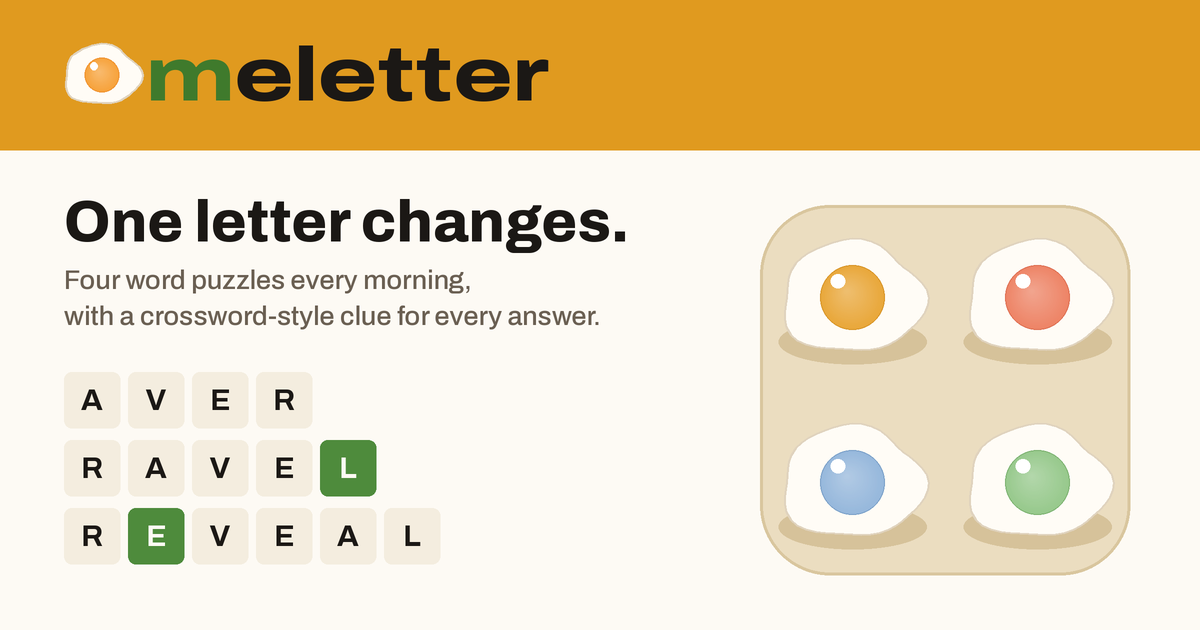
A worked example: AVER → RAVEL → REVEAL
Let’s walk through a real chain from the game’s own example. You’ll see exactly how the rule works in practice.
Step 1: Start with the first answer.
The first word is AVER (letters: A, V, E, R). This is your base.
Step 2: Read the clue for the next answer.
The clue tells you what the next word means. In this example, the next word is RAVEL (as in “to tangle or unravel”). But you don’t need to guess it from scratch — you know it must be made from AVER plus one letter.
Step 3: Add one letter and rearrange.
AVER has four letters. RAVEL has five. So you’re adding one letter. Which one? The missing letter is L. Add L to AVER, then rearrange the five letters to get RAVEL.
- AVER + L → RAVEL (rearranged)
Step 4: Repeat for the next link.
Now your base is RAVEL (R, A, V, E, L). The clue points to REVEAL. That’s six letters, so again you’re adding one. This time the added letter is E. RAVEL already has one E, so you add a second E, then rearrange all six letters to form REVEAL.
- RAVEL + E → REVEAL (rearranged)
And so the chain continues: each step is just “add or remove one letter, then anagram.”
Tip: When you’re stuck, write the current word’s letters alphabetically. Then try adding each letter of the alphabet one at a time and see if any anagram jumps out. Removing works the same way — take away one letter and see what’s left.
How to approach your first daily puzzle
- Start with the first answer. It’s usually the easiest, and it gives you the letter set for the next clue.
- Count the letters. If the next answer’s clue seems longer or shorter, that tells you whether you’re adding or removing a letter.
- Use the clue as a filter. The clue isn’t just decoration — it tells you the meaning of the target word. So when you have a few possible anagrams, the clue picks the right one.
- Work one link at a time. Don’t try to see the whole chain at once. Just focus on getting from the current word to the next.
The puzzles are set by a human, so the clues are fair and the words are real (they come from a shared word list). That means you won’t run into nonsense combinations — every answer is a legitimate word.
What about the other games?
Omeletter has nine game modes in total, including Fold, Soufflé, Flip, Roux, Reduction, Double Yolk, Scratch, Fork, and Lattice. Four of them appear each day. Most use the same one-letter-change rule, but Double Yolk has a rule of its own — so don’t be surprised if that one behaves differently. For the others, the basic “add or remove one letter, then rearrange” principle is your foundation.
Once you’ve solved your first chain, the daily puzzles will feel much less intimidating. The rule is simple, but the anagramming is the fun part. Give it a try — and remember, you only ever need to change one letter at a time.